
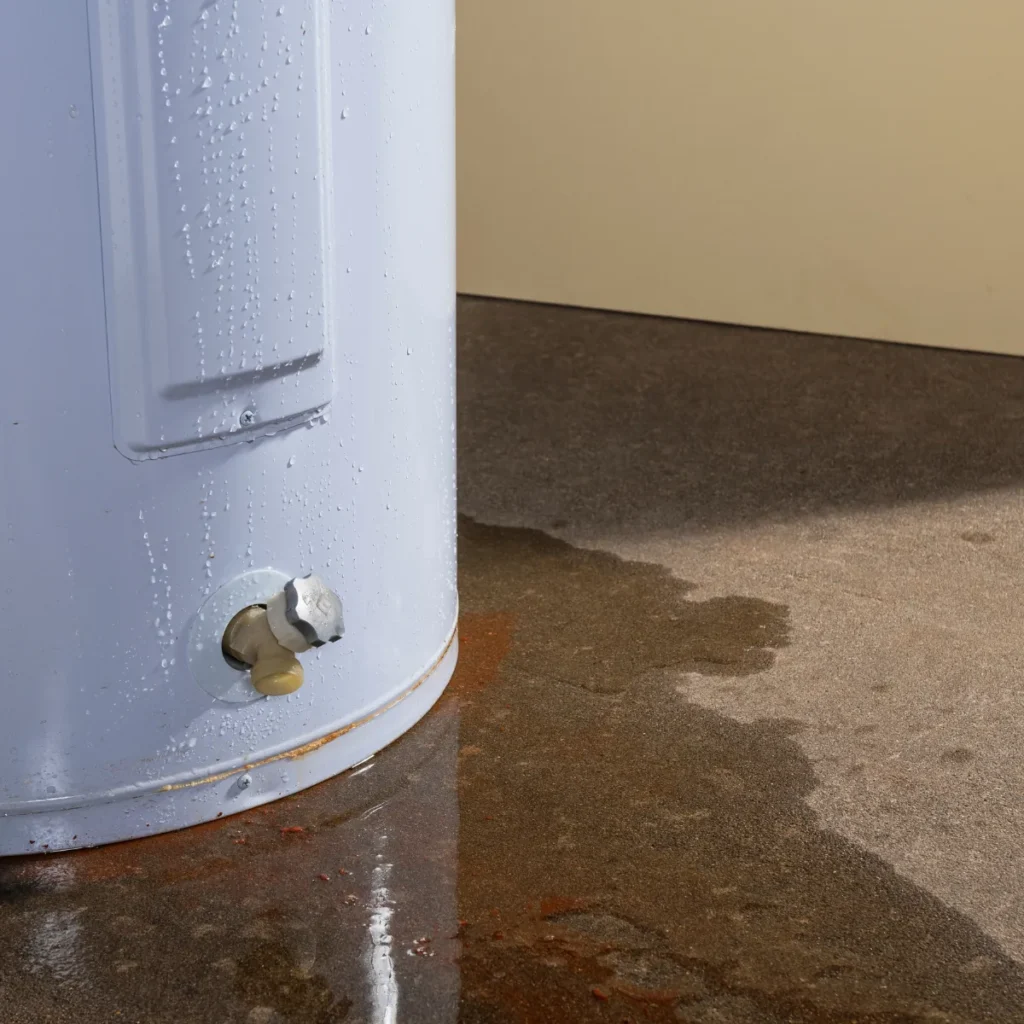
If your water heater is leaking from the bottom, stop using it and arrange professional diagnosis. A puddle at the base can come from more than one place; it does not, by itself, prove that the tank must be replaced. For a Clarksville homeowner or renter, the first priorities are safe isolation of the source and a separate check of any affected property.
Tell the plumber whether the water is still spreading, where it is visible and whether access is unsafe. If flooring, walls or stored belongings are wet, mention that when requesting a property-damage assessment. Replacing a heater and assessing the surrounding room are different jobs.
Keep clear and arrange safe isolation
Wet electrical equipment, hot water and unsafe access
Keep people and pets out of the affected area. Do not step into water to reach a breaker, plug, valve or appliance. Water near electrical equipment requires an appropriate professional response. Do not touch leaking water or open the unit to investigate its temperature or source.
CDC guidance warns against operating electrical equipment while standing in water. If electrical isolation would require crossing water, keep clear and arrange qualified help instead.
Source: CDC electrical safety guidance.
Follow the exact heater manual
Water heaters have different controls and energy sources. Follow the shutdown instructions for your exact model only when you can identify the controls and reach them safely. If you are unsure which supply or control serves the heater, leave isolation to a qualified professional. Do not experiment with controls to find out.
A. O. Smith recommends consulting the model’s manual and arranging professional diagnosis. Its guidance calls for shutting off the heater’s energy source and water supply before inspection. That is not a reason to approach an inaccessible control or carry out a generic shutdown procedure for an unfamiliar unit.
Source: A. O. Smith water-heater leak guidance.
What a puddle at the base can and cannot tell you
Visible observations without testing or disassembly
From a safe position, note whether water appears around a visible connection, near the drain valve, in the pan or along the floor. Take photographs only if doing so does not require approaching the equipment or entering the wet area. Record what you can see and leave the diagnosis open.
The manufacturer’s guide identifies connections, valves and internal tank problems among possible leak sources. It also discusses condensation that can be mistaken for a leak. These possibilities need to be distinguished by someone assessing the actual heater; they are not a checklist for assuming a harmless explanation.
Do not drain or flush the heater, test a pressure-relief valve, adjust the temperature, remove covers or attempt a repair to see whether the leak stops. Give the plumber the model information from an existing manual, receipt or accessible label. Do not move equipment to read a label.
Plumber diagnosis versus property-damage assessment
Source repair or replacement is a separate decision
Ask the plumber to identify the source and explain the recommendation in writing. Does the proposed visit include diagnosis only? Is a repair possible for the identified problem, or is replacement recommended? What would be included in the authorized work, and what additional decision may be needed?
Do not use the age of the heater or the location of a puddle as the sole basis for choosing replacement. Request an explanation tied to the findings. Keep any estimate, model details and service record together so that you can compare the recommendation with the work completed.
Nearby flooring, walls and stored items
Describe where water traveled beyond the heater. Include the edge of nearby cabinetry, flooring joints, baseboards, adjacent rooms and stored items if they appear affected. You do not need to declare that these materials are damaged; explain where assessment may be needed.
Confirm who is responsible for each part of the response. The plumber may address the source while a restoration provider assesses building materials. Flooring, drywall or finish work may involve another trade. Ask each business what its visit covers and what it will hand off to someone else.
If you rent in Clarksville, contact emergency maintenance and follow up in writing. Report the location, active water and access concerns. Ask who will authorize the plumber and any property assessment before arranging building repairs yourself.
Five details to report before the visit
- The heater’s location and model information already available without approaching the wet area.
- When you first noticed water, including whether the actual start time is unknown.
- Where water is visible and whether it appears to be spreading.
- Any nearby electrical equipment, difficult access or other safety concern.
- Which rooms, materials or belongings may need assessment beyond the heater itself.
A short factual report is enough to start: “Water is visible at the base of the heater in the utility room. I noticed it this morning, but I do not know when it began. The floor near the wall is wet, and I cannot safely reach the controls.” Avoid adding a diagnosis that has not been confirmed.
Before the appointment ends, ask what was found, what work was completed and whether the unit must remain out of use. Request a clear restart instruction from the professional responsible for the heater. Also ask who will follow up on any surrounding-property concerns that remain unresolved.
Leaking water heater FAQs
Should I keep using a leaking water heater?
Stop using it and arrange safe, model-specific isolation and professional diagnosis. Do not continue using the unit while waiting to see whether the puddle grows. Keep clear if reaching the controls is unsafe.
Does water at the bottom mean the tank must be replaced?
It does not establish the source on its own. A professional should distinguish a connection or valve issue from an internal tank problem and explain the recommendation for your unit.
Who should diagnose the source?
Contact a plumber or qualified water-heater service professional. Describe the model, visible water and access concerns, and confirm that the business handles the type of heater you have.
What should I report before the plumber arrives?
Give the discovery time, location, known model information and safe observations. Say whether water is still spreading and whether controls are inaccessible. Do not test the unit or touch components to gather more detail.
Who assesses surrounding property damage?
Ask whether the plumber’s scope includes affected building materials. If it does not, request a separate property-damage assessment and confirm who coordinates any subsequent flooring, wall or finish repairs.
Related local water-damage guides
Request a Clarksville water-damage referral
Call 931-645-1285 to request a water-damage provider referral for your Clarksville property. Share the heater location, visible spread and access concerns. Property Water Damage is an independent referral and dispatch service. The provider performing the work confirms availability, arrival, assessment, scope and pricing. Water-heater diagnosis or replacement may require a separate plumbing appointment.